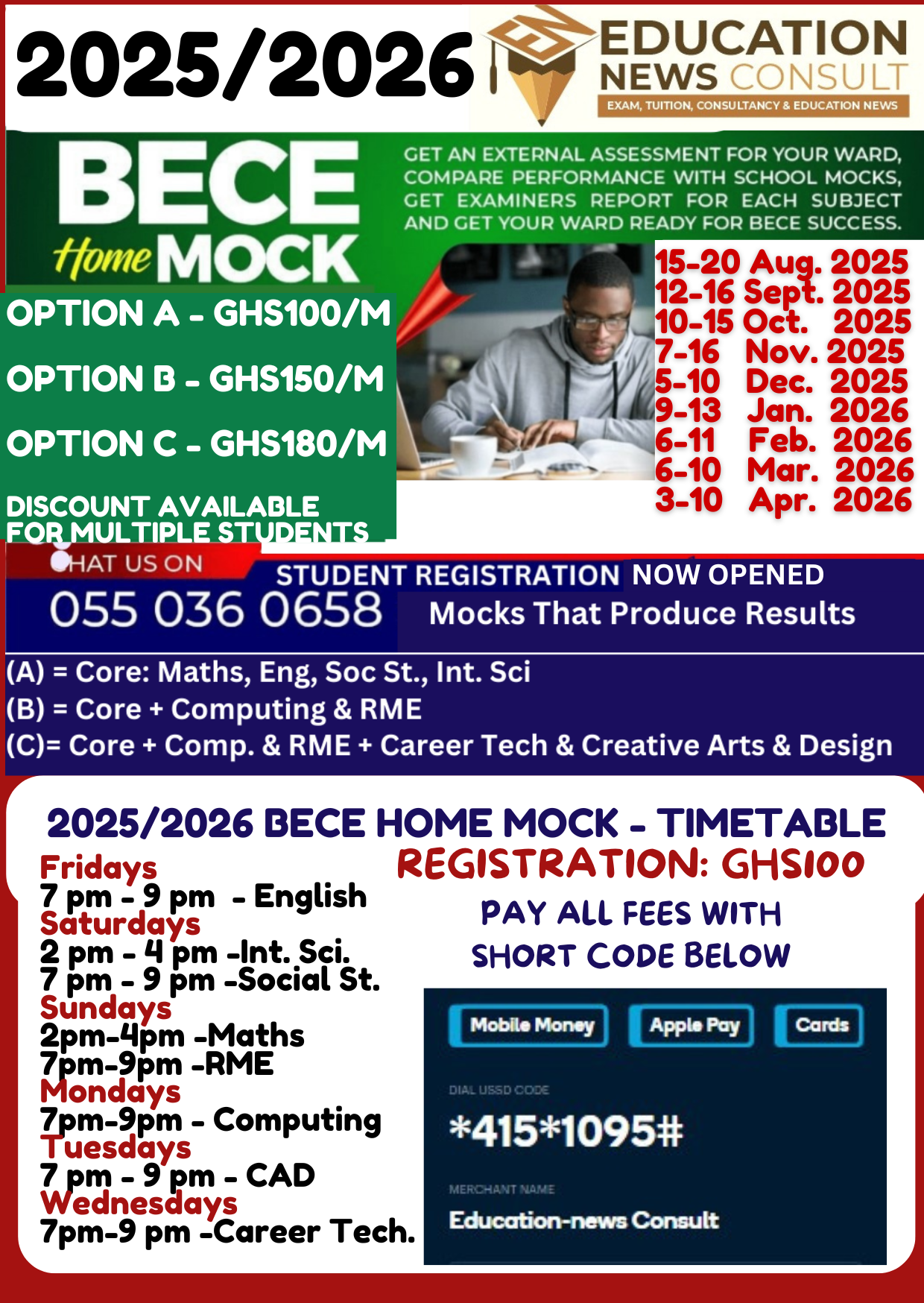
The BECE Home Mock Report for October 2025 Towards 2026 BECE Has Been Released. This report consolidates and summarizes student performance across all subjects—Mathematics, Science, Computing, Social Studies, Religious and Moral Education (R.M.E.), English Language, Creative Arts & Design (CAD), and Career Technology—for the October 2025 Mock Examination.
The overall results suggest a foundational grasp of concepts (evidenced by generally good objective scores) but an alarming and persistent failure to apply knowledge, execute procedures, and maintain technical rigor, particularly in the compulsory, higher-mark questions across all papers.
Our Mock Services:
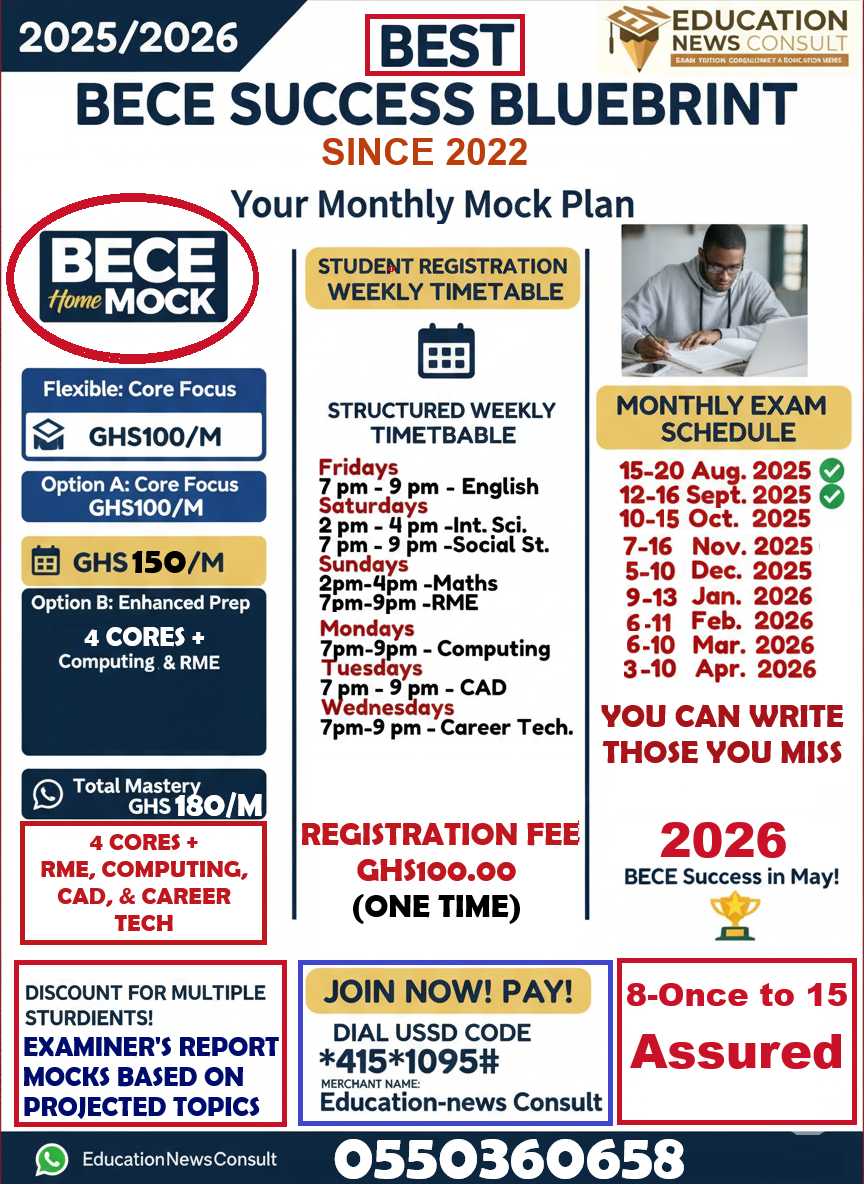
The consult will run two different mocks towards the 2026 BECE.
- School Mocks – Time table below.
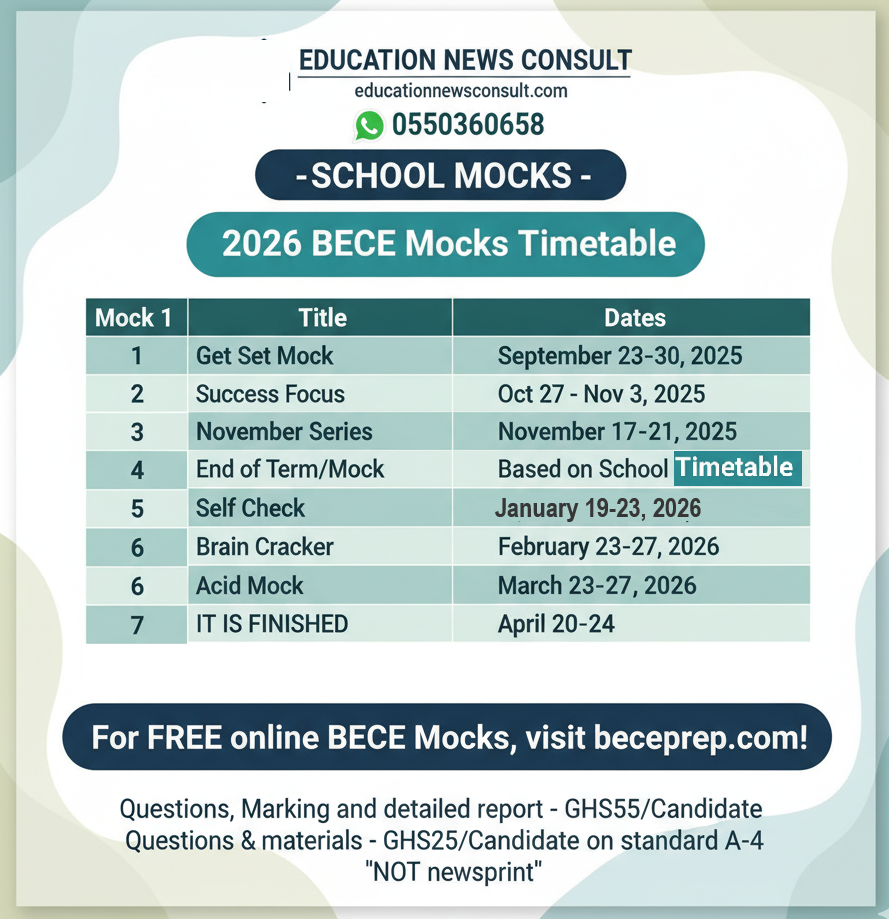
BECE HOME MOCKS TIMETABLE
I. General Performance Summary
| Subject | Overall Performance | Core Weakness |
| Mathematics | Weak | Procedural errors, poor formula substitution, weak graphical skills (Pie Chart), and unit omission. |
| Science | Mixed/Weak | Confusion of fundamental definitions (mass/proton number), poor application to real-life scenarios, and fear of calculation questions. |
| Computing | Very Poor | Lack of broad knowledge, confusion between key concepts (VR/AR), and ignoring instructional words. |
| Social Studies | Good/Mixed | Lack of depth in explanation and difficulty with defining fine civic/historical distinctions. |
| R.M.E. | Strong | Failure to articulate distinct, specific administrative functions (SSNIT). |
| English Language | Average/Good | Consistent linguistic errors (spelling, concord, punctuation) in long-form writing. |
| CAD | Weak | Poor fundamental drawing skills, lack of technical terminology, and weak application of concepts. |
| Career Technology | Unacceptable | Inability to create concise design briefs or formulate effective analytical questions (Ergonomics/Function). |
READ: September BECE Home Report Out, Mock Exposes Critical Gaps in Student Preparedness
II. Detailed Subject Analysis and Key Areas of Concern
A. Core Academics (Mathematics, Science, Computing)
| Subject | Specific Findings and Examples |
| Mathematics | Procedural Breakdown and Conceptual Errors: Candidates exhibited a lack of basic mathematical discipline. Many failed to show clear workings in Paper 2. Common errors included substituting incorrect formulas (e.g., instead of ) and struggling to simplify basic algebraic expressions involving coefficients and powers (e.g., ). The Pie Chart question revealed widespread difficulty in accurately calculating proportions and translating them into graphical form. |
| Science | Confusion of Foundational Terminology: A significant number of students confused ‘mass number’ with ‘proton number’ and ‘anion’ with ‘cation’. Inadequate Application: Candidates struggled to link scientific knowledge to real-life situations like the greenhouse effect. There was also a clear avoidance of calculation questions, suggesting a fear of quantitative problem-solving. |
| Computing | Shallow Knowledge & Guesswork: Section A scores were extremely poor (average score ), indicative of guesswork rather than broad knowledge. Candidates consistently mixed up key concepts like Virtual Reality (VR) and Augmented Reality (AR) and lacked awareness of industries utilizing Artificial Intelligence (AI). Simple instructional words (“explain,” “state”) were often ignored. |
B. Humanities (Social Studies, R.M.E., English Language)
| Subject | Specific Findings and Examples |
| Social Studies | Lack of Explanatory Depth: While core facts (e.g., elected president, unicameral legislature) were known for the First Republican Constitution (Q1a), answers frequently described the effects (“centralized power,” “absence of a vice-president”) rather than the official features as required by the scheme. This highlights a struggle with providing the fine distinctions needed for higher marks. |
| R.M.E. | Vague Institutional Knowledge: Performance on moral and narrative questions was strong (e.g., Chastity, Prodigal Son). However, articulating the explicit administrative functions of SSNIT (Pension, Invalidity, Survivors benefits, Managing funds) was a widespread weakness, with students offering only general benefits like “saving for the future”. |
| English Language | Technical Inaccuracy in Extended Writing: Despite good objective scores, essays and speeches were marred by recurring mechanical errors: spelling, punctuation, and subject-verb agreement (concord). This resulted in unnecessary loss of marks, emphasizing a need for intense proofreading practice. |
C. Practical & Creative Subjects (CAD, Career Technology)
| Subject | Specific Findings and Examples |
| Creative Arts & Design | Poor Technical Application: There is a pronounced lack of rigor in technical drawing. The compulsory still life (Q1) showed poor outlines and struggles with recognizing objects. The requirement to use and explain specific shading techniques (e.g., cross-hatching, stippling) was largely missed, revealing a weak theoretical-practical link. |
| Career Technology | Failure in Problem Structuring: The fundamental task of creating a concise Design Brief (Q1) was overwhelmingly failed; candidates merely restated the scenario. Furthermore, articulating appropriate Ergonomics and Function analysis questions was challenging, pointing to a severe gap in basic design process skills. The vagueness of technical terms persisted, with expressions like “Improper or wrong measurement” used instead of precise terms like inaccurate measurements or wastage of materials. |
💡 Recommendations for Students and Encouragement
Dear Home Candidates,
Your performance shows you are covering the syllabus, but covering it is not enough; you must master the skills. The jump from passive recall (Paper 1) to active application (Paper 2) is where you are losing critical marks. These subjects are the foundation of your future careers—treat them as such.
🌟 Your Action Plan for Improvement
1. Master Technical Rigor and Presentation (Maths & Science)
- Show Your Work (Mathematics): In Paper 2, show every step of your calculation, even for seemingly easy questions. Always check to ensure you are using the correct units in your final answers. Do not omit the units in your final answers.
- Conquer Calculations (Science): Stop avoiding the calculation questions. They are often the easiest to score if you know the formula and procedure. Seek dedicated practice until you overcome the initial “fright”.
- Define and Distinguish (Science/Computing): Create flashcards for frequently confused pairs (e.g., Anion vs. Cation, VR vs. AR, Mass Number vs. Proton Number).
2. Elevate Explanation and Depth (Humanities)
- Explain the “So What?” (Social Studies/R.M.E.): Never end a point with a mere definition. If you state a feature, follow up by explaining its significance or effect.
- Example (SS): Instead of: “Ghana became a Republic.” Use: “Ghana officially became a Republic, meaning the British monarch was replaced by an elected Ghanaian Head of State, giving citizens power to elect their leader.”
- Be Specific, Not General (R.M.E.): Practice listing the four distinct functions of key institutions like SSNIT (e.g., Pension, Invalidity, Survivor Benefits, Fund Management) to move beyond generic answers like “saving money.”
3. Shift to Active Skills and Technical Language (CAD & Career Tech)
- Practice the Practical (CAD): You must draw to improve. Allocate time daily to practice drawing basic forms (cubes, spheres, cylinders) and applying the specified shading techniques (Hatching, Stippling, Cross-hatching) . You must also learn to accurately sketch and label tools like the Marking Gauge.
- Design Process Mastery (Career Tech):
- Practice drafting Design Briefs and Analysis Questions until they are concise and technically correct. This is a compulsory skill that carries major marks.
- Familiarize yourself with the technical language: use “wastage of materials” or “inaccurate measurements” instead of vague terms like “it takes time”.
Review: The Design Brief Structure
This topic seems not to have been treated in many schools. It is a target topic for 2026 BECE
The Design Brief is a concise statement derived from the complex Situation. It tells the designer exactly what they need to create and why it must meet certain criteria.
Correct Structure (The Three W’s)
A complete Design Brief should succinctly cover:
- WHAT needs to be created.
- WHY it is needed (the purpose/aim).
- WHO is the primary user.
| Design Brief Component | Example from the Mock Exam (Mensah’s Problem) |
| Action Verb & Product (WHAT) | Design and make a pouring unit… |
| Purpose (WHY) | needed to help him transfer fuel… |
| Constraint (The “Must-Have”) | …without waste (or spillage). |
Common Student Error vs. Correct Approach
The major error seen in the mock exam was that students often just described the problem (The Situation) or offered an incomplete solution.
| Incorrect Student Response (The Situation) | Correct Design Brief (The Solution Aim) |
| “Mensah struggles to transfer fuel from a gallon to his car’s fuel tank, causing fuel to spill.” |
“Design and make a pouring unit needed to help him transfer fuel without waste.” |
Why This Matters
Mastering the Design Brief and its related component, the Analysis Question, directly addresses the weakness identified in the Career Technology performance.
| Component | Purpose in the Exam |
| Design Brief (Q1.i) | Secures your first marks by correctly stating the problem’s solution objective. |
| Analysis Questions (Q1.ii) | Shows the examiner you understand the technical Function (e.g., flow rate) and user Ergonomics (e.g., wrist strain). |
Questions with suggested answers for Design and Making – Target Topic for 2026 BECE – Career Technology
Question: Mr. Danso is physically challenged and cannot cross the busy road to buy food. Write a design brief, write two specifications under Function, Ergonomics and Cost, Slit three materials that can be used to make the unit, suggest three best tools and finishes to add aesthetic beauty to the artifact.
Design Solution for Mr. Danso (Accessibility Unit)
Situation: Mr. Danso is physically challenged and cannot cross the busy road to buy food.
1. Design Brief (Compulsory Question Aim)
Design and make a safe, accessible mobile unit needed to allow a physically challenged user to easily and reliably transport essential items (like food) across a busy road without external assistance.
2. Specifications (Design Requirements)
| Heading | Specification 1 (Focusing on Mr. Danso) | Specification 2 (Focusing on the Environment/Cost) |
| Function (What it must do) | The unit must be capable of carrying a minimum weight of 5 kg (food/groceries) and be designed to be stable even when stopping or starting abruptly. | The unit must be remotely controlled and operate reliably at a distance of at least 30 meters to span the width of the busy road. |
| Ergonomics (How the user interacts with it) | The control mechanism must be operable using minimal hand strength (e.g., a simple joystick or large buttons) to accommodate a user with limited dexterity. | The unit’s height must be low enough to be loaded/unloaded easily from a wheelchair without excessive bending or reaching. |
| Cost (Financial feasibility) | The total material and component cost for the unit should not exceed GH₵ 500 to remain affordable. | The unit must operate on a rechargeable battery that lasts for at least 6 hours of intermittent use to minimize recurring fuel costs. |
3. Materials, Tools, and Finishes
| Category | Item (Three Required) | Purpose / Aesthetic Enhancement |
| Suitable Materials | 1. Plastic (ABS or PVC) | Lightweight, durable, and weather-resistant for the frame/casing |
| 2. Aluminum (Aluminium tubing) | Strong, lightweight metal for the chassis or supporting structure | |
| 3. Rubber (Rubber wheels/tires) | Provides grip and acts as a shock absorber for smoother movement[cite | |
| Best Tools | 1. Hand Drill | Used to bore precise holes for mounting motors and axles. |
| 2. Hacksaw | Used for cutting the aluminum or plastic frame components to size. | |
| 3. Measuring Rule | Essential for ensuring accurate dimensions and placement of all parts. | |
| Aesthetic Finishes | 1. Paint (Bright Yellow or Orange) | Enhances visual appeal and drastically increases the unit’s visibility to drivers on the busy road. |
| 2. Lacquer / Clear Varnish | Applied over painted surfaces to provide a glossy, smooth finish and add an extra layer of protection against weather/dirt | |
| 3. Reflective Tape | Applied to all four sides to maximize night-time visibility and safety (aesthetic beauty with a functional purpose). |
Your objective scores prove you can learn the content. Now, you must focus on the discipline and the technical application to secure your future career pathway.
Team Lead:
Wisdom Hammond